Quick answer
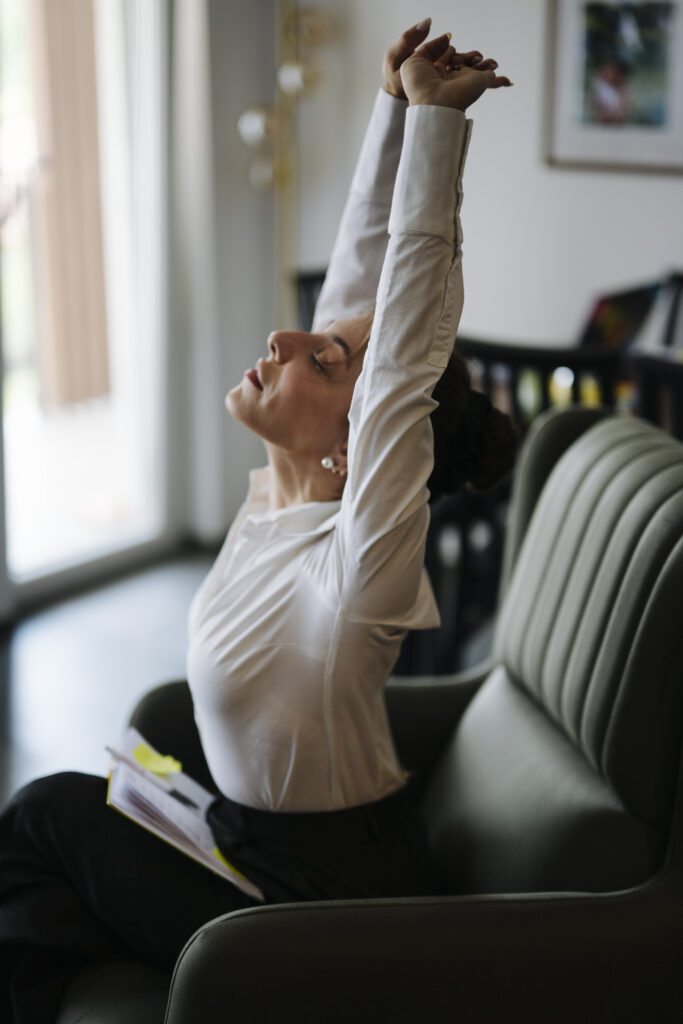
Stretching is an exercise method; flexibility is a range-of-motion capacity. “Mobility work” commonly describes exercises that practice moving through a range you can control. These categories overlap: stretching and strength training can both improve range of motion. For everyday stiffness, start with comfortable movement rather than forcing a deeper stretch. Add stretching when improving a particular range is your goal—not because every stiff feeling proves a muscle needs lengthening. (pmc.ncbi.nlm.nih.gov)
1. Flexibility, active range of motion and stretching are different things
The terminology becomes clearer when you separate what your body can do from how you train it.
- Flexibility describes the available range of motion around a joint. Tissue properties and how much stretch a person tolerates both contribute.
- Active range of motion is movement you produce using your own muscles, without someone or something moving the limb for you.
- Passive range of motion is movement produced with outside assistance, such as a clinician moving a relaxed limb. Research distinguishes active and passive measurements; they are not interchangeable. (pmc.ncbi.nlm.nih.gov)
For example, lifting your arm overhead under your own power uses active range of motion. Having a clinician move the relaxed arm assesses passive range. Neither is a do-it-yourself diagnostic test.
Stretching is one way to train range of motion. Static stretching involves holding a position; dynamic stretching involves repeated, controlled movement. A stretch does not have to be passive, and movement does not stop being stretching simply because you are not holding still. (pmc.ncbi.nlm.nih.gov)
For this article, mobility work means practicing comfortable, controlled joint movement. Think of gently bending and straightening your elbows or rolling your shoulders—not necessarily an elaborate routine. The U.S. Department of Veterans Affairs describes mobility exercises using these kinds of simple movements. (news.va.gov)
The useful question is therefore not “Which label is better?” It is “What movement do I want to make easier?”
2. What stretching and range-of-motion research actually supports
The clearest supported benefit of regular stretching is improved range of motion.
A review published in the March 2024 issue of the Journal of Sport and Health Science pooled 77 studies in healthy participants. Repeated stretching programs lasting at least two weeks improved range of motion overall. Static stretching and contract–relax stretching techniques produced greater long-term gains than dynamic or ballistic stretching in that analysis. That comparison concerned range-of-motion gains—not which exercise feels best during a work break. (pmc.ncbi.nlm.nih.gov)
A 2026 review of 79 randomized trials also found improved lower-limb flexibility with repeated static stretching. However, studies differed substantially, and the authors identified possible small-study effects. Most studies involved young adults; the findings should not be generalized automatically to painful shoulders or complex medical conditions. (link.springer.com)
Strength training can improve range of motion too. A 2023 review of 55 studies in healthy participants found improvements with resistance training, particularly training using external loads. It detected no significant difference between resistance training and stretching in their effects on range of motion. This does not prove that every exercise or program works equally well for every joint. (pmc.ncbi.nlm.nih.gov)
The practical implication: you do not necessarily need a separate, lengthy stretching session to become more flexible. Strength work and stretching can be complementary options.
These reviews also do not establish that any routine marketed as “mobility” will fix pain, prevent all injuries or improve every daily task.
3. Feeling stiff does not automatically mean your muscles are too short
A sensation of tightness is not the same thing as a measured loss of movement. Mayo Clinic’s sports-medicine guidance notes that perceived stiffness does not always correspond to reduced mobility or flexibility. Persistent tightness may need assessment rather than progressively harder stretching. (sportsmedicine.mayoclinic.org)
Nor does improved flexibility necessarily mean a muscle has become permanently longer.
A 2025 review examined 65 studies involving adults, mostly younger men. Static stretching produced small reductions in measured stiffness, while repeated stretching increased stretch tolerance. The pooled results did not show a significant increase in muscle fascicle length—the length of bundles of muscle fibers. (link.springer.com)
That distinction matters because “I feel tight” is not enough information to identify the cause or choose a treatment.
Before choosing exercises, describe the problem in ordinary terms:
- Does the sensation occur only after sitting, or throughout the day?
- Can you perform the movement comfortably, even though it feels stiff?
- Is there pain, swelling or a new restriction?
- Does gentle movement help, make no difference or worsen it?
Treat these as observations to guide your next step, not a method for diagnosing yourself.
4. Choose the approach that matches your goal
Use the following as a practical decision guide, not a clinical assessment.
If you want a break from sitting: begin with gentle active movement. Chair-based mobility exercises can be performed in a small space without exercise equipment. You do not have to reach the limit of every joint’s motion. (news.va.gov)
If you want more range in a particular movement: consider a targeted, comfortable stretch practiced regularly. Mayo Clinic recommends smooth stretching without bouncing, normal breathing and tension rather than pain. Its general guidance suggests holding a stretch for about 30 seconds and practicing at least two or three times a week. Those are general guidelines, not a requirement for every desk-break exercise. (mayoclinic.org)
If you want strength as well as flexibility: do not assume stretching must replace resistance training. Research supports resistance training as another way to improve joint range. Choose an appropriate exercise and manageable resistance rather than forcing a loaded movement deeper. (pmc.ncbi.nlm.nih.gov)
If you already move comfortably through the range your activities require: there is no need to turn maximum flexibility into a personal score. Pick a specific reason for adding more work.
If pain is the main problem: do not use a generic flexibility routine as treatment. Persistent symptoms deserve professional advice. (sportsmedicine.mayoclinic.org)
You can combine approaches, but give each a purpose: movement practice for a break, stretching for a range goal, and strength work for developing strength.
5. Try this short, gentle desk-break sequence
This is an illustrative sequence, adapted from NHS seated exercises—not a tested treatment for desk-related stiffness or a replacement for a workout.
Use a stable chair without wheels, with your feet resting on the floor. Leave enough room to move. If you are unsure whether these exercises suit you, ask a healthcare professional. (nhs.uk)
| Movement | How to do it | Example amount |
|---|---|---|
| Seated hip march | Sit upright. Hold the chair sides, lift one bent knee comfortably, then lower with control. Alternate legs. | 5 lifts per leg |
| Ankle point and flex | Support yourself on the chair. Extend one leg comfortably, lift the foot and slowly point the toes away, then toward you. | 5 cycles per foot |
| Upper-body turn | Keep feet planted and hips still. Cross your arms over your chest; turn your upper body comfortably, then return. | 3 turns per side |
| Gentle chest opening | Sit upright, move shoulders back and down, and open your arms slightly. Lift your chest gently without forcing an arch. | 2 holds of 5–10 seconds |
The exercise choices and movement cues come from NHS guidance; the shorter turn and chest-opening amounts are editorial adaptations for a brief break. Start with fewer repetitions or a smaller movement if needed. Skip any movement that hurts. (nhs.uk)
Worked example: Suppose your goal is simply to move between two blocks of computer work. Try one round at a natural pause, then note whether the movements were comfortable and whether you feel different afterward. “No change” is a valid observation—not a reason to force more range.
If standing or walking is comfortable and practical, you can choose that instead. The sequence is an option, not an obligation.

6. Check progress without chasing a bigger stretch
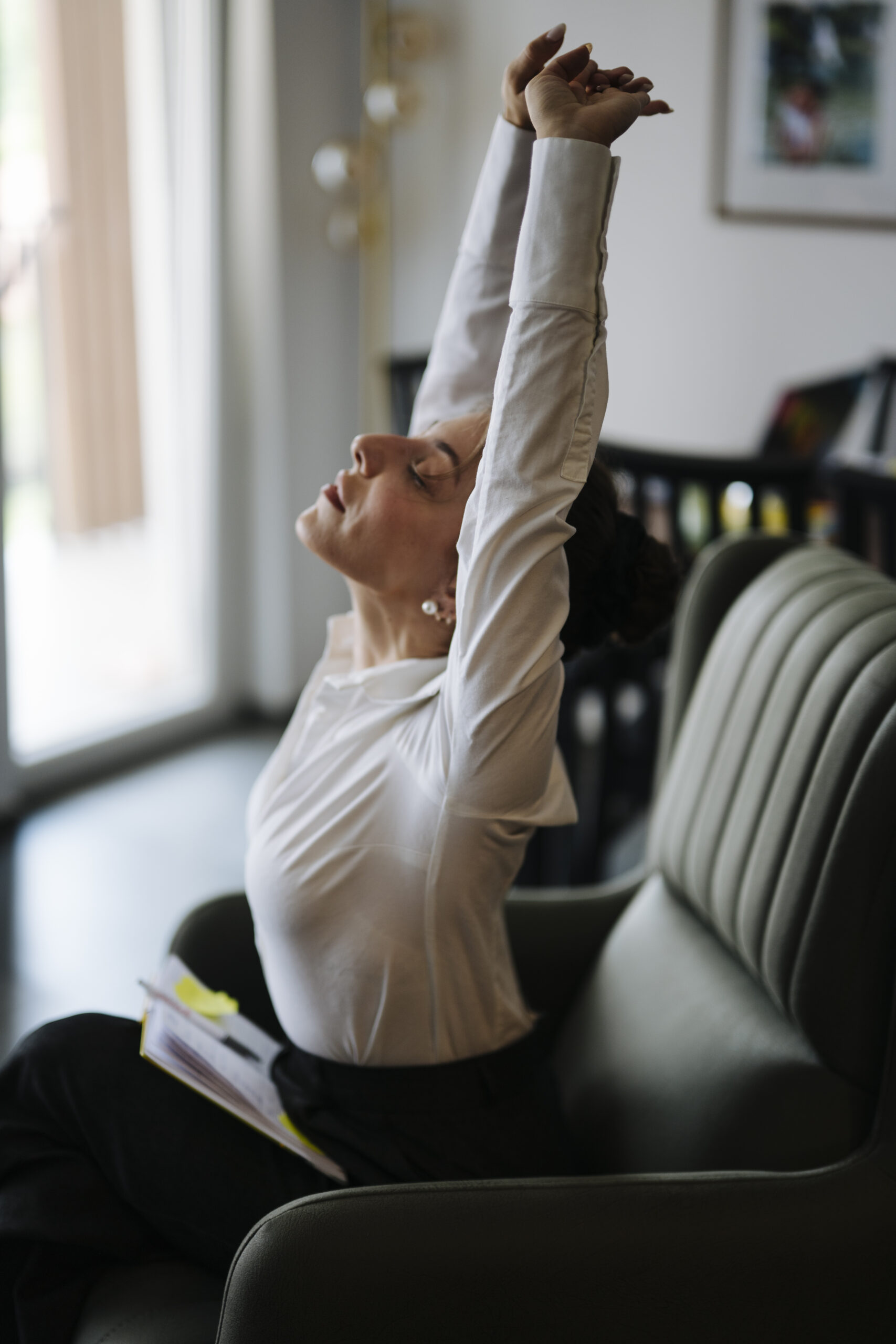
Choose a simple movement relevant to your goal—such as comfortably turning your upper body—and keep the comparison consistent.
For a personal log, record:
- whether you completed the planned practice;
- whether the movement felt comfortable;
- whether the everyday task seemed easier;
- whether symptoms appeared during or afterward.
Do not treat a deeper reach immediately after stretching as proof of a lasting change. Research distinguishes a single session’s effects from adaptations after repeated training. (link.springer.com)
If practice remains comfortable, change just one thing at a time: add a few repetitions, repeat the short sequence at another convenient break, or spend more time on a specific stretch. NHS guidance advises building repetitions gradually. (nhs.uk)
There is no need to promise yourself a particular gain by a deadline. Studies use different joints, tests, populations and training programs; their averages cannot predict your individual result. (pmc.ncbi.nlm.nih.gov)
7. Avoid these common mistakes—and know when to get help
Forcing through pain. A stronger sensation is not a useful progress measure. Back off a painful stretch; use smooth movement rather than bouncing. (mayoclinic.org)
Assuming every stiff area needs stretching. If repeated stretching does not resolve persistent tension or pain, seek assessment rather than simply increasing intensity. (sportsmedicine.mayoclinic.org)
Replacing your whole exercise plan with flexibility work. Flexibility activities alone do not fulfill aerobic or muscle-strengthening recommendations. Keep them as one part of your activity plan. (pmc.ncbi.nlm.nih.gov)
Ignoring symptoms because the routine is “gentle.” Arrange medical advice if joint pain interferes with normal activities or sleep, gets worse or keeps returning, or has not improved after two weeks of home care. Morning joint stiffness lasting more than 30 minutes also warrants assessment. (nhs.uk)
Seek urgent medical care for a hot, swollen, painful joint or joint pain accompanied by fever or feeling unwell. Severe pain after an injury, inability to bear weight, an obviously displaced joint, or numbness or tingling around the joint after injury requires emergency assessment. These warning signs are not reasons to try a deeper stretch. (nhs.uk)
Bottom line: Start with the movement you want to make easier. Use comfortable active movement for a simple break, targeted stretching for a flexibility goal, and strength training where appropriate. Judge the practice by comfort and usefulness—not by how extreme the position looks.