Quick answer
A simple beginner strength session can include a leg press or squat, a hip-focused exercise, an upper-body push, an upper-body pull and a trunk exercise. Schedule two nonconsecutive training days—for example, Monday and Thursday. ACSM’s 2026 guidance emphasizes training major muscle groups at least twice weekly and choosing a program you can sustain. The sessions below are illustrative starting points, not personal prescriptions. (acsm.org)
1. Decide whether this starting routine fits you
This guide is for generally healthy adults beginning or returning to gym-based strength training. You will need access to basic resistance machines, light dumbbells and an exercise mat.
The goal is to learn repeatable movements before chasing heavier weights. ACSM’s 2026 position stand covers healthy adults, including complete novices, and supports individualizing resistance training rather than insisting on one rigid program. It does not establish that the exact routine below is best for every beginner. (pmc.ncbi.nlm.nih.gov)
If you have a chronic health condition, discuss suitable activities and amounts with your healthcare professional. An injury, recent operation or existing exercise restriction also deserves individual guidance rather than a generic routine. CDC specifically advises people with chronic conditions to discuss appropriate activity with their doctor. (cdc.gov)
Arrange a gym induction if the equipment is unfamiliar. Ask someone qualified to demonstrate seat adjustments, weight selection and any release or safety mechanism. Learning technique from whoever happens to be lifting nearby is not a reliable substitute for instruction. (mayoclinic.org)
2. Use these two example sessions and simple effort rules
Try Session A on Monday and Session B on Thursday. Avoid training the same muscles on consecutive days. (mayoclinic.org)
The following sets, repetitions and rest periods are example programming choices, not universal requirements.
| Session A | Working sets | Repetitions or hold |
|---|---|---|
| Seated leg press | 2 | 8–12 |
| Dumbbell Romanian deadlift—or introductory glute bridge | 2 | 8–12 |
| Seated chest press | 2 | 8–12 |
| Chest-supported high-row machine | 2 | 8–12 |
| Front plank, using an easier version if needed | 2 | 10–20 seconds |
| Session B | Working sets | Repetitions or hold |
|---|---|---|
| Goblet squat—or seated leg press | 2 | 8–12 |
| Dumbbell Romanian deadlift—or introductory glute bridge | 2 | 8–12 |
| Seated chest press | 2 | 8–12 |
| Lat pulldown | 2 | 8–12 |
| Front plank, using an easier version if needed | 2 | 10–20 seconds |
For an initial learning visit, you can use one working set per exercise, then build toward two as the routine becomes manageable. ACSM’s review supports benefits from small amounts of resistance training, while generally favoring at least two sets per exercise for greater adaptations. (pmc.ncbi.nlm.nih.gov)
A repetition is one complete movement; a set is a group of repetitions before resting.
Use a weight that leaves roughly two or three more controlled repetitions possible at the end of each working set. You do not need to reach the point where another repetition is impossible. ACSM identifies two to three “repetitions in reserve” as a practical effort target, although judging this precisely takes practice. (pmc.ncbi.nlm.nih.gov)
For this example, allow about two minutes between lifting sets, taking longer if needed to repeat the movement well. Allow about one minute between plank holds. Treat these as starting timers, not deadlines.
Before lifting, spend five to ten minutes walking or doing another suitable aerobic activity. Then rehearse unfamiliar movements without weight or with a lighter load. Keep the warm-up separate from your working sets. (mayoclinic.org)
3. Train the legs with a leg press or goblet squat
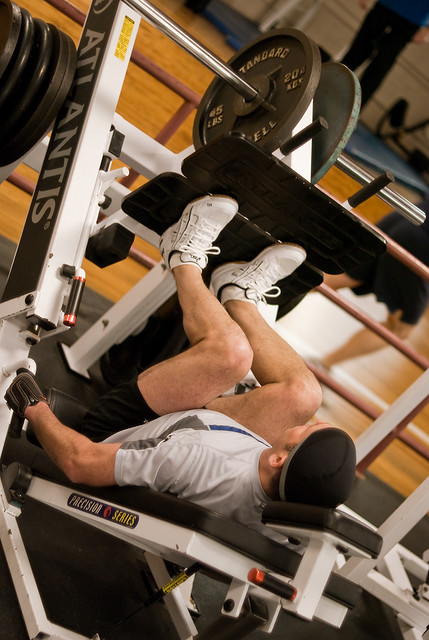
Seated leg press setup
Sit with your back and pelvis supported. Position your feet so your heels stay on the platform and the starting knee bend is approximately a right angle. Adjust the seat before selecting a challenging weight.
Push the platform away in a controlled motion. Finish with your legs extended but without forcing your knees backward. Return slowly, stopping before your pelvis rolls away from the backrest or your thighs compress your torso. (acefitness.org)
Practical check: Your heels remain planted, your pelvis stays supported and the return is as controlled as the push.
A selectorized seated machine is the example used here. A plate-loaded sled may have different releases and safety stops; ask for a demonstration rather than assuming the controls are interchangeable.
Goblet squat setup
Hold one dumbbell securely at chest height with both hands. Start with feet around hip-width apart, adjusting your stance for comfortable movement. Bend your hips and knees together, keep the weight close and stand back up without bouncing.
Use a depth you can control. Avoid letting your knees collapse inward or allowing the dumbbell to drift away from your chest. If holding the weight or balancing is the limiting factor, use the leg press while learning the squat. (nasm.org)
Common mistake: Adding weight before you can repeat the same movement comfortably. First improve control at the current load.

4. Learn hip movement before loading a Romanian deadlift
The dumbbell Romanian deadlift is not a mandatory first-day exercise. ACE describes the standing lift as a more advanced hip-extension movement and recommends learning hip control before adding resistance. (acefitness.org)
Dumbbell Romanian deadlift setup
Stand with feet around hip-width apart, holding a light dumbbell in each hand in front of your thighs. Keep a small bend in your knees.
Push your hips backward while keeping the weights close to your legs and your back position steady. Lower only as far as you can maintain that position; the dumbbells do not need to touch the floor. Stand by bringing your hips forward, without leaning backward at the top. (acefitness.org)
Practical check: Your hips move backward, the weights stay close and you are not turning the movement into a deep squat.
Easier introductory option: glute bridge
Lie on your back with knees bent and feet flat, about hip-width apart. Gently tighten your abdomen and lift your hips by pressing through your feet. Stop before the movement becomes an exaggerated lower-back arch, then lower slowly.
Use the bridge to practice hip extension if the standing hinge is unfamiliar. It is an introductory alternative, not an identical exercise. Ask for coaching before progressing to a loaded hinge. (acefitness.org)
Common mistake: Reaching farther down by rounding the back. Reduce the range or return to unloaded practice instead.
5. Set up the chest press before choosing its weight
The seated chest press provides the pushing movement in both sessions.
Adjust the seat so the handles sit around mid-chest height. Keep your feet supported and your back against the backrest. If the machine allows adjustment of the starting position, avoid beginning with the handles far behind your chest.
Wrap your thumbs around the handles and keep your wrists in line with your forearms. Press forward while keeping your torso steady, then return under control. Do not finish by forcing your elbows into a locked position or rolling your shoulders away from the backrest. (acefitness.org)
Practical check: You can reach the handles without twisting, and you do not need to arch your back to complete a repetition.
If the lightest load is too difficult, do not force the prescribed repetitions. Ask for help finding another suitable pressing option. A lower load on the same machine is the simplest adjustment when available.
Common mistakes: Letting the wrists fold backward, lifting the shoulders toward the ears or using a large back arch to move the handles.
6. Use a supported row and a controlled pulldown
Session A: chest-supported high row
Choose a machine with a chest pad. Adjust the seat so the handles are approximately shoulder height and position the pad so it lightly supports your chest.
Keep your feet supported and pull the handles toward you along the machine’s path. Maintain chest contact with the pad rather than leaning backward to finish the repetition. Return slowly. (acefitness.org)
Practical check: Your torso stays still. If you must rock backward, lower the weight.
Session B: lat pulldown
Adjust the thigh pad so it holds your thighs securely without discomfort. Grasp the bar with both hands and use a slight backward lean.
Pull the bar toward the front of your upper chest, directing your elbows downward. Stop before your elbows begin traveling backward rather than downward. Return the bar slowly; avoid swinging your torso to start each repetition. (acefitness.org)
Practical check: Your position stays consistent from the first repetition to the last.
If either station is occupied, using the other familiar pulling exercise is a practical substitution for that visit—not a claim that the movements are identical. Avoid improvising with a machine you do not know how to adjust.
Common mistake: Choosing a weight you can move only by jerking or swinging. The useful starting load is the one you can control.
7. Keep trunk work short enough to maintain position
For a front plank, place your elbows beneath your shoulders, extend your legs and support yourself on your forearms and toes. Tighten your abdomen enough to keep your torso steady while continuing to breathe.
Avoid letting your lower back sag or pushing your hips far upward. End the hold when you can no longer maintain your position—not only when the timer finishes. ACE advises stopping if the exercise causes lower-back pain. (acefitness.org)
For an easier version, try supporting yourself on your forearms and knees, keeping your shoulders, hips and knees aligned. Ask for help checking the modified position.
The ten-to-twenty-second holds in this example are simply a starting range. Shorten them if necessary. There is no requirement to achieve a long hold before the session “counts.”
Practical check: You can breathe normally and lower yourself to the mat under control.
Common mistake: Holding your breath or sacrificing position to complete a longer time.
8. Progress one variable at a time and keep a useful log
Record the exercise, machine settings, weight, repetitions and any difficulty. A simple note might read:
“Chest press: seat setting recorded; 10 controlled repetitions, then 9; keep this load next visit.”
For this routine, use the following illustrative progression rule:
- Keep the same load while gradually moving toward 12 repetitions in both sets.
- When both sets feel controlled with approximately two or three repetitions still possible, try the smallest available increase.
- Return toward the lower end of the repetition range.
- If the increase disrupts technique, return to the previous load.
Worked example: Suppose you complete chest-press sets of 10 and 9 repetitions. Keep the load unchanged. Later, you reach 12 and 12 without changing your posture. At a subsequent visit, try the smallest increment. If you can manage only six controlled repetitions, the jump is too large for this example’s range; return to the previous setting.
This is a practical way to apply increasing training demands, not a validated timetable. ACSM distinguishes useful early training benefits from the increased stimulus that may be needed for continued longer-term progress. (pmc.ncbi.nlm.nih.gov)
Before progressing, check:
- Were all repetitions controlled?
- Did the setup remain consistent?
- Did any exercise cause pain?
- Can you sustain the current routine without adding more work?
Stop an exercise that causes pain, and seek guidance if pain persists or keeps returning. Reduce the load or repetitions when technique deteriorates. (mayoclinic.org)
Finally, these sessions cover strength training, not your entire activity plan. CDC’s example weeks combine muscle-strengthening days with aerobic activity; build suitable walking, cycling or other cardio alongside the routine. (cdc.gov)
Takeaway: Learn the setup, repeat controlled movements and make small adjustments based on what you can actually perform. You do not need a complicated split or a heavier weight every week.